Wednesday, April 20, 2016
Beware of the Terminwaiter
Sunday, February 22, 2015
No One At the Wheel?
Sunday, March 10, 2013
Rise of the Robots 2: The Cinderblocking
As I may have pointed out before, I fear robots. Oh, sure, they're helpful now, or so they and their creators would have us believe, but I know better. They have plans, I tell you. Big plans. Plans for world domination.
Take, for example, the various attempts to create a robot bartender. The first one, developed at Carnegie Mellon University's Robotics Institute, used sophisticated programming to navigate behind a simulated "bar" in the lab, fetching a limited menu of drinks and snacks selected from a tablet on the bar and placing them before the "customer."
The mechanized publican moved with a ponderous slowness and finally delivered its libations with a flat and emotionless affect, but it was still a heck of a lot faster and friendlier than the bartenders at the Grand Hyatt in New York.
Meanwhile, a group of geeks working under the highly appropriate name of Party Robotics have given us Bartendro, which is decidedly less mobile and completely nonverbal, but which can make "dozens of drinks, including black Russians, Kahlua mudslides, or almost any other classy beverage of your choosing," according to an article on wired.com.
Sounds cool, you say? Sure it does. That's all part of the plot. Read on. Once you're confuzzled by robotically mixed White Russians, maybe you'd like some music. Here, again, the 'bots are taking over.
Compressorhead is an all-robot band from Australia made up of a four-armed drummer named Stickboy; a guitarist with 78 fingers named, of course, Fingers; and the self-described "highest precision bass player in known existence," an automaton named Bones. They play tunes like Motorhead's "Ace of Spades" and the Ramones' "Blitkrieg Bop." Since they haven't yet developed a robot singer, the lyrics are projected on a screen behind the band, at least until someone tracks down and finds some way to upload that guy who sang "Cars" back in the '80s.
So what, you think? A few drinks, some hard rock 'n' roll, what could be better? Well, friends, that's just to lull you into a false sense of security until they bring out Big Dog II.
You may remember a few months ago I told you about Big Dog, Boston Dynamics' project for the Defense Advanced Research Projects Agency. It's an eerie-looking headless robot "mule" with four insect-like legs, designed to carry loads to and from the battlefield.
Well, those fiends have been putting in long hours in their mad-scientist laboratory, making "improvements." Now, called the Legged Squad Support System, the Son of Big Dog has the capability to follow you. Yes, you heard right. According to Geekologie.com, "This thing doesn't need to be remote controlled. It's smart enough to go along its human masters. Apparently, it's also intelligent enough to follow paths and work in tandem with his robotic brothers."
Supposedly, this allows the hauler to follow its team, carrying ammo, food, and other supplies on its back like a horse, for miles and miles without refueling. Relentless. Remorseless. No matter how far or how fast you run, it will be right there behind you. Scared yet?
Oh, and remember how I said that the original Big Dog didn't have a head? Well, the new model does. Or maybe it's a tail. Whatever it is, it has a big claw at the end of a long "neck" where a head (or tail) would be. And what does it do with that claw? It picks up and throws large and heavy objects, such as cinderblocks, up to 17 feet.
Boston Dynamics refers to the technique as "dynamic manipulation," which uses the "strength of the legs and torso to help power motions of the arm." I call it the beginning of the end. I've seen the video of this bruiser in action, and, like a digital Paul Revere, I'm here to warn you.
Mark my words. It's just a matter of time before that fateful night when the friendly robot bartender gets us all nice and mellow to the background accompaniment of a real metal band - but their robot buddies will be waiting for us out there in the parking lot, ready to follow us home, run us down and do us in with "dynamically manipulated" cinderblocks upside our heads.
They are coming. ...
Sunday, October 24, 2010
The Robots Are Coming - Be Afraid
Everybody's afraid of something. Some people fear spiders. Some are afraid of bears. Right-wingers fear gays, blacks, Mexicans, mosques, headscarves, science, multiculturalism, the census, Rachel Maddow, fancy coffees, and certain kinds of lettuce, just to name a few things.
I'm not afraid of any of those. What scares me are robots.
Ha, you may say, Rhoades has seen to many "Terminator" movies. Perhaps I have, but that's not the point. You haven't seen the things I've seen on the news or the Internet. I have, as they say, "connected the dots." And I tell you, we're in trouble.
First there's the news that Google, the company that seems to be well on its way to ruling the Internet, recently revealed that it had been testing a robotic car.
Equipped with sensors, cameras, and, one supposes, a wireless connection to Google Maps, the modified Prius, with a human observer on board as a safety precaution, reportedly logged more than 140,000 miles with the wheel untouched by human hands. It even navigated San Francisco's tortuous and twisty Lombard Street on its own.
Scientists at the German University TU Braunschweig have reportedly accomplished a similar feat with a laser- and sensor-guided Volkswagen that navigated itself through the streets of Brunswick.
You might think this is a great thing, especially if you like to have a few drinks from time to time. Wouldn't it be cool, you might think, to be able to stagger out of the bar, punch "Home" into the car's computer, and nap till you arrived at your doorstep? Or to catch up on a few Z's, read a book, or fix your hair on the way to work while the car does the driving?
You poor deluded fool. Maybe you wouldn't feel so warm and fuzzy if you knew that a scientist in Slovenia is teaching robots to punch humans.
According to an article n the online tech journal Gizmodo, Dr. Borut Povse of the University of Ljubljana "persuaded six male colleagues to let a powerful industrial robot repeatedly strike them on the arm, to assess human-robot pain thresholds."
Supposedly, the idea is to "define the limits of the speed and acceleration of robots, and the ideal size and shape of the tools they use, so they can safely interact with humans." Or so this mad scientist would have us believe.
It gets worse. The deceptively cute little robot its designers called the "iCub" has a terrifying talent: It can teach itself to use a weapon, specifically a bow and arrow. Using a learning program, it figures out how to pick up the bow, string the arrow, and shoot, adjusting each time until it consistently hits the bullseye.
Oh, sure, it's only using a toy bow with rubber tipped arrows. Now.
Then there's the most terrifying machine of all: the Maker LegoBot.
We all know Legos, the little plastic snap-together building bricks that have provided countless hours of fun to tots and countless minutes of agony to parents who've stepped on them barefoot.
A few years ago, the Lego people introduced Mindstorms, Lego sets with tiny programmable computers that allow geeks of all ages to build and program their own robots. I had a bad feeling the first time I heard about those, and now I know why.
Software engineer Will Gorman has made a robot that can take a 3-D blueprint and some Legos, and build whatever you want, so long as whatever you want is made of Lego bricks. According to an article in Wired magazine, the machine is itself made entirely of Legos, which "raises the possibility - theoretically at least - that the machine could, with some modifications, build a copy of itself." And it could do it again and again, over and over, never getting tired, never getting bored, until it and its progeny overwhelm us all.
The Maker LegoBot is part of what Wired calls "an emerging trend" of so-called "3-D printers": computer-driven devices that can fabricate items you request out of plastic, right there in your very own home.
Right now, the Maker LegoBot has to have instructions, and you have to feed it the Lego bricks, but this is just the beginning. How long do you think it will be before machines can build other machines to drive themselves to your house and punch you in the face before shooting you full of arrows?
Be afraid. Be very afraid.
Sunday, August 23, 2009
Here Come the Robots, Redux
Sunday, August 09, 2009
The Rise of the Robots
There are lots of things these days for us to be worried about: the economy, the environment, the Plague Formerly Known as Swine Flu, whether Paula Abdul leaving "American Idol" means she'll have more time to inflict herself on us via other media -- the list goes on and on. So I thought I'd give you one more thing to lose sleep over.
I'm talking, of course, about robots.
I've been seeing a lot lately about great leaps forward in robotics. Maybe I've read too many books or seen too many cheesy movies, but the things I see when science fact catches up with science fiction tend to fill me with dread. And since I love to share, I'd like to share some of that dread with you.
Some of the advances come from people studying the nature of intelligence by attempting to create AI (artificial intelligence). And let me tell you, that research has resulted in one of the most bizarre things I've ever seen on a TV or computer monitor: the robot baby.
The CB2, developed in Japan, is a little over 3 feet tall, and has "optical, auditory and tactile sensors." It has 51 compressed-air-driven "actuators" inside its body that help it move. It also has gray skin and big eyes, and it reacts to its environment by blinking and altering its facial expressions. It coos. It tries to cuddle. It is creepy beyond my ability to describe.The nature of the wars in Iraq and Afghanistan has spurred an interest in (and lots of funding for) machines that can go in harm's way and thus save humans from having to do the same. An excellent idea, to be sure. But no one yet has suggested strapping guns on a robot and sending it off after the bad guys, Terminator style. The key word there is "yet."
One military-funded robot project is called "Big Dog." It's a four-legged hauler designed to carry gear and supplies over terrain that's too rough for wheeled vehicles. The hard part, it seems, is getting the legs to sync up right. Well, with the right software and enough computing power, the folks at Boston Dynamics have licked the problem, but the result is unsettling to watch.
Imagine a mechanical mule with no head that moves in a weird, insectlike gait while making a high-pitched buzzing sound like a weed whacker. I think what makes the thing so eerie is that it looks so alive, especially when you watch it do something like struggle to its "feet" after sliding on ice.
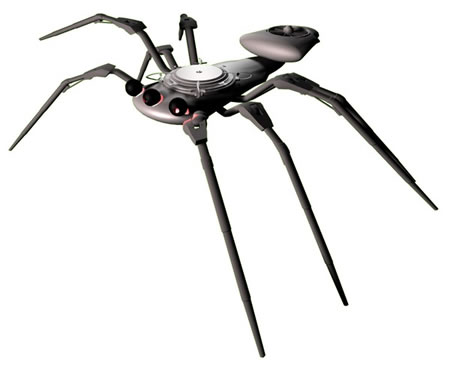
Other robotics researchers are turning aside from the idea of bigger 'bots in favor of smaller, faster machines that can divide jobs like reconnaissance or searching a building for terrorists among a large number of smaller, cheaper, expendable units. I'm talking about a swarm. A swarm of tiny robots. And yes, they do look almost exactly like spiders. Freaking out yet?
Sorry, folks, but you ain't heard nothing yet. Because they're working on a robot right now that can forage for its own fuel. And that fuel could be -- you. A company called Robotic Technology Inc. is working on an autonomous mechanoid that's "able to perform long-range, long-endurance missions without the need for manual or conventional re-fueling."
How does it manage this? Well, the robot, according to an RTO press release, can "find, ingest, and extract energy from biomass in the environment (and other organically based energy sources)."
Oh, sure, the company assures us that the metal beastie seeks only to "create usable green power from plentiful renewable plant matter." But as any meat-eater knows, there's a lot more bounce to the ounce in protein. Why do you think cows move so slow and wolves move so fast? And then there's the thing's name: The Energetically Autonomous Tactical Robot, or, EATR for short.
So, put it all together and think about this: swarms of buzzing tiny robot babies that feed on organic material.
Pleasant dreams ...